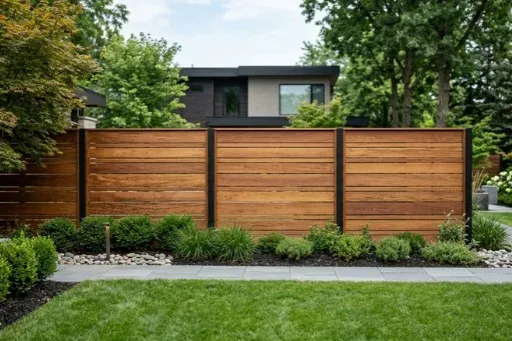
The upper edge of a fence can change how the entire boundary relates to a home's architecture, landscaping, and outdoor spaces. A straight, level top creates a simple outline, while a shaped profile can introduce movement, highlight individual sections, or give an entrance more presence. For a custom wood fence in Raleigh-Durham, the choice is about more than decoration: the top edge influences the fence's proportions and the impression it creates from different viewpoints. With planning support from Top Rail Fence Raleigh-Durham, you can explore a profile that complements your property without making the design feel unnecessarily complicated.
Start with the outline you want people to notice
The top edge is one of the first features people see when looking across a fence. Because it creates a continuous visual line, even a modest change in its shape can distinguish a custom wood fence from a standard panel layout.
Keep the clean geometry of a level top
A straight top edge works well when the aim is a restrained, orderly appearance. Its horizontal line can complement contemporary homes, simple rooflines, and yards with geometric landscaping. It also gives the fence a consistent silhouette along long property boundaries.
Choosing a straight profile does not mean settling for an ordinary result. Board width, spacing, post caps, and the relationship between panels can provide plenty of visual interest. During wood fence installation, these details can be coordinated to create a distinctive design while retaining the simplicity of a level outline.
Introduce a gentle arch between posts
An arched profile creates a gradual rise or curve across a panel. Depending on its depth and repetition, it can soften the fence's appearance and give the boundary a more decorative character.
This approach may suit a garden enclosure, a backyard entertainment area, or a prominent section near an entrance. The curve should be proportionate to the panel width. A shallow arch often creates a subtle effect, while a more pronounced curve makes the shape a stronger design feature.
Use a stepped profile for visual definition
A stepped top changes height in distinct increments rather than following a smooth curve. It can create a structured pattern across a series of panels, particularly when the fence incorporates substantial posts or clearly defined sections.
For a custom wood fence, consider how the steps align with the posts and nearby architectural features. Repeated, consistent transitions usually look more deliberate than abrupt changes introduced without a clear pattern.
Coordinate the top edge with the home's architecture
A fence should look like it belongs on the property rather than appearing as an unrelated decorative feature. The roofline, window shapes, porch details, and exterior materials can all provide useful clues when selecting a profile.
Echo architectural lines without copying everything
A home with strong horizontal lines may pair naturally with a straight fence top, while a property with curved garden features or rounded architectural details may benefit from a softer profile. The objective is to establish a visual relationship, not reproduce every feature of the house.
During fence installation, compare the proposed outline with the home's most noticeable exterior details from the street. A profile that supports the overall composition can add character without competing with the building.
Balance decorative tops with substantial posts
Posts create visual pauses along the fence and help define individual panels. Their height and shape affect how a custom top edge is perceived.
If the panel tops feature arches or steps, consider keeping the posts relatively simple so the design does not become crowded. Alternatively, understated panel tops can work alongside more prominent post caps. For a cohesive custom wood fence, decide which element should attract the most attention before combining several decorative features.
Decide where a shaped edge will have the greatest impact
Not every section of a perimeter needs to carry the same visual emphasis. A custom profile can be especially effective where the fence frames a view, marks an entrance, or forms a backdrop for an outdoor feature.
Give the front-facing section its own identity
The portion of a fence visible from the street often contributes significantly to curb appeal. A distinctive top edge can make this section feel more considered, particularly when it frames a walkway or sits alongside a landscaped front yard.
Think about the distance from which the fence will usually be viewed. Small curves and subtle steps may be difficult to distinguish from far away, while dramatic shapes can dominate the frontage. A well-proportioned custom wood fence should remain attractive at street level and when viewed more closely.
Make a garden boundary feel less rigid
A garden can provide an opportunity to introduce a more expressive fence profile. A gently shaped top can complement informal planting, flowering borders, and mixed-height greenery. A stepped design may suit a garden with defined beds, clipped shrubs, and more structured paths.
The surrounding plants should still have room to grow without obscuring every detail. Consider the mature height of shrubs and climbing plants before settling on the final profile, particularly if the top edge is one of the main features you want to display.
Treat gates as part of the overall composition
A gate can become a focal point when its top edge relates to the surrounding panels. Matching the gate's profile to the fence creates continuity, while a carefully chosen variation can help distinguish the entrance.
During wood fence installation, account for the gate's width, hardware, clearance, and operation alongside the decorative shape. The design should look balanced when the gate is closed and remain practical when it is in use.
Choose board arrangements that support the profile
A shaped top edge depends on more than the outline alone. The arrangement of the boards determines how clearly that shape reads and whether the finished fence looks polished.
Compare individual pickets with a solid panel
Individually arranged boards can make an arched or stepped profile more noticeable because the top of each board contributes to the overall silhouette. Solid or closely fitted panels create a more continuous surface, so the shape may read as a single architectural line.
Review wood fencing options to compare styles and consider which arrangement best supports your preferred top edge. The right choice depends on the desired level of privacy, the overall fence height, and the visual character of the property.
Keep spacing and board proportions consistent
Even a creative outline can look untidy if the boards vary unintentionally in spacing or alignment. Consistent dimensions help the shaped edge appear deliberate and maintain a balanced rhythm across each section.
A well-planned custom wood fence should account for how the profile meets the posts, whether the end boards need special cuts, and how the pattern continues around corners. These construction details deserve attention before materials are cut, rather than being treated as finishing adjustments.
Consider durability alongside the design
A decorative edge should remain suitable for outdoor exposure and routine maintenance. The wood species, quality of the cuts, finish, and installation method all influence how the completed fence performs.
Plan for moisture and weather exposure
Cutting boards into curves or angles creates exposed end grain that may require particular attention during finishing. Appropriate preparation and a suitable exterior wood treatment can help protect vulnerable surfaces, depending on the wood species and product used.
Ask your installer how the selected profile will be cut, finished, and maintained. For broader inspiration, Better Homes & Gardens' fence ideas can help you compare different visual approaches before deciding which details suit your property.
Avoid decorative complexity that adds little value
Multiple curves, alternating heights, elaborate caps, and contrasting details can compete with one another if they are all used in the same design. Choose one defining feature and let the remaining elements support it.
A simple arched edge may be enough to distinguish the fence, while a straight top paired with carefully selected post caps may better suit a property with restrained architecture. The strongest result is not necessarily the most elaborate one. It is the design that looks intentional and works with the home's exterior.
Give your fence a finish that feels personal
A standard straight line remains a practical and attractive option, but it is not the only way to create a well-designed boundary. An arch, a stepped outline, or a thoughtfully detailed gate can give a custom wood fence a distinctive identity while preserving its everyday purpose.
In Raleigh-Durham, consider the home's architecture, the fence's visibility, the surrounding planting, and the amount of decorative detail you want to introduce. Top Rail Fence Raleigh-Durham can help you evaluate these choices and plan a wood fence installation that balances appearance with practical requirements. If you are ready to explore a tailored profile for your property, Contact Us to discuss your ideas and find a custom wood fence design that feels right for your home.